
Nursing students gain new perspectives through elderly suits
A new thesis shows that simulation in a so-called elderly suit - carried out in a home-like environment - gives nursing students a stronger understanding of what it can be like to live as an elderly person with various health problems. The effects are clear both immediately after the exercise and over a longer period of time.
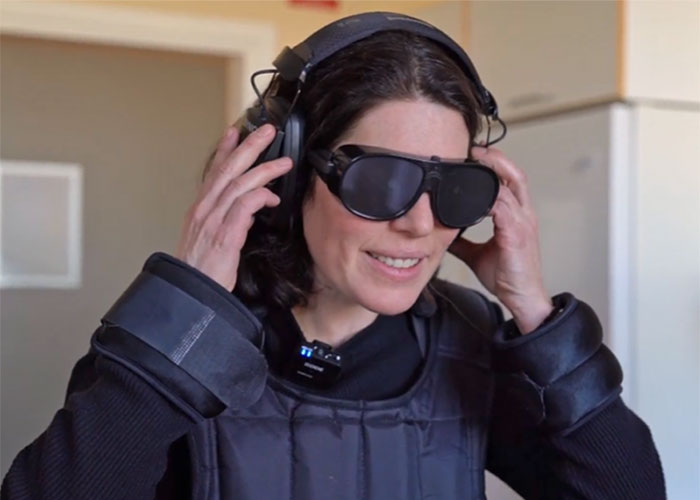
Nurse Sofia Örtlund Eklind testing an elderly suit.
As more and more healthcare is transferred to the primary and municipal levels, nurses will increasingly encounter and care for older people in their homes. However, there are challenges in that nursing students may feel unprepared and unmotivated to care for older people. Furthermore, ageism is a problem that permeates not only society but also healthcare and future nurses.
"That is why it is important for nursing education to address these challenges early on through new teaching methods, such as simulation with elderly suits. This simulation is based on students shifting their perspective, challenging their previous assumptions, and getting a glimpse of what it might be like to live with various age-related health problems as an older person. Previous research has shown that this can strengthen students' empathy and understanding," says Björn Bouwmeester Stjernetun, doctoral student at the School of Health Sciences at Jönköping University and lecturer at the University of Skövde.
In previous studies, simulations with elderly suits have rarely been tested in a home environment or followed up over a longer period of time. Often, the suit has only been used to represent normal aging, without including the health problems that many people over the age of 85 live with.
Insight into the importance of person-centered care deepened
The students describe how the simulation deepened their understanding of the importance of person-centered care - being present, responsive, and giving time. They also reflected on the home as a care environment, where welfare technology can be both a support and a risk depending on how it is used.
One of the most prominent results was how strongly visual impairment affected the experience. When the students took on the role of a blind elderly person or companion, it turned out that communication between them was crucial to how well they worked together.
"The results show that the students approached the roles in two distinctly different ways. Either they cooperated and worked together, or they focused primarily on their own needs and became increasingly distant from each other. A decisive factor in how this turned out was their ability to communicate - both through words and body language," says Björn.
More positive attitude towards caring for the elderly
The results show that students who participated in the simulation have a more positive attitude towards caring for older people compared to those who did not participate – both in the short and long term. The study also indicates that the second year of study is a good time for the simulation, as the students already have a foundation on which to reflect.
In summary, the study shows that simulation with elderly suits is an effective way of teaching based on experiential learning, which can strengthen students' understanding and insight into ageing and how different health problems affect the experience of autonomy and participation. This is important knowledge when meeting older people in healthcare and putting theoretical knowledge into practice.
Björn Bouwmeester Stjernetun defended his doctoral thesis, "Knowing me, knowing you: Bridging perspectives through age suit simulation intervention in nursing education," on 27 February. Read the thesis here.
Facts
An elderly suit simulates what it is like to be older, for example with glasses that impair vision, hearing protection that impairs hearing, and imitates tinnitus. Weights are used to simulate loss of muscle mass, and special shoes disrupt balance. The suit used by the School of Health Sciences can illustrate eight different medical conditions, such as stroke, diabetes, and hemiplegia.
Video showing the elderly suit being tested


